

Dr Leah Deutsch has extensive experience supporting women through their fertility journey in to pregnancy, birth and beyond as an NHS doctor in obstetrics & gynaecology. She works as a senior registrar in a busy London hospital and is a member of the Royal College of Obstetricians & Gynaecologists.

Pelvic girdle pain (PGP) affects around 1 in 5 pregnant women, yet it is widely misunderstood — even by the professionals women turn to for help. We asked obstetrician and pregnancy yoga teacher Dr Leah Deutsch to explain why it happens and what genuinely helps.
About Dr Leah Deutsch
Dr Leah Deutsch (MBBS MRCOG LLB RYT500) has extensive experience supporting women through fertility, pregnancy, birth and beyond as an NHS doctor in obstetrics and gynaecology. At the time of this interview she was working as a senior registrar in a busy London hospital, and she is a member of the Royal College of Obstetricians and Gynaecologists.
Leah discovered yoga in 2001 and is now a Yoga Alliance registered teacher. She has trained internationally and holds advanced 500+ hour qualifications in Vinyasa, Ashtanga, Hatha, Yin and pregnancy yoga, which shape her balanced, intelligently sequenced classes. Through her Instagram community, @yoga_doc, she shares resources, advice and support on fertility, pregnancy and the postpartum period.
What is pelvic girdle pain?
Pelvic girdle pain is one of the things I talk about most, both as a pregnancy yoga teacher and as an obstetric doctor. It ranges from occasional discomfort to severe pain that, in rare cases, limits mobility so much that a wheelchair is needed.
PGP can affect anyone, but it mainly affects pregnant women, with a small group continuing to have symptoms after birth. Around 1 in 5 pregnant women experience it. Add lower back pain into the mix and the figure rises to around half, with some studies reporting up to 70%. In short, it's really common.
PGP can start any time from around 14 to 30 weeks of pregnancy. You may feel pain over the sacroiliac joints (the dimples at the back of your pelvis), which can spread across the buttocks or into the thighs. Some women also feel pain at the front of the pelvis, over the pubic bone.
Before making this diagnosis, your midwife or doctor should check for red-flag symptoms such as fever, numbness or weakness in the legs, or problems with the lower spine or discs, to rule out anything more serious.
Understanding the structure of the pelvis, and what happens to it in pregnancy, is key to understanding this condition.

Breaking down the anatomy
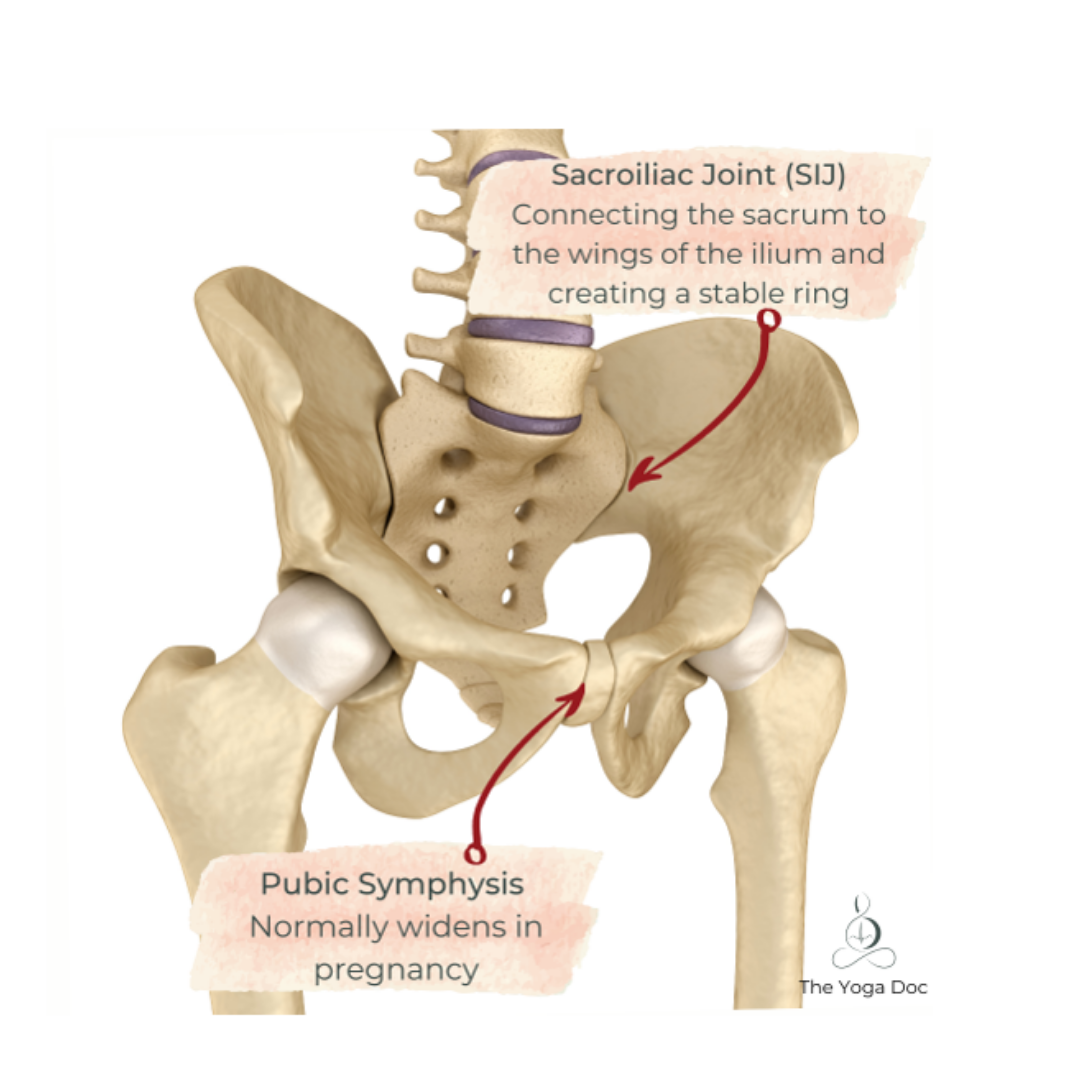
The pelvis is a solid, strong structure. It is a ring made up of the sacrum (the fused, plate-like base of your spine, between your lower back and your coccyx) and two large hip bones. At the back, each hip bone joins the sacrum at a sacroiliac joint. At the front, the two hip bones meet at the pubic symphysis, a joint held together by tough cartilage and ligaments.
Together these form a strong, stable, bowl-like ring. That stability is worth remembering — we'll come back to it.
In pregnancy, hormones (mainly relaxin) cause the ligaments throughout the body to soften. This is a normal, natural process that every pregnant woman goes through. Unfortunately, it has given rise to a widely held but false theory: that this normal laxity causes pelvic girdle pain. Spoiler: it doesn't.
Debunking the myths
This biomechanical explanation is often given to women in pain by well-meaning healthcare and fitness professionals. Sadly, it can make the problem worse, feeding fear from the very people we trust for help.
The research doesn't support it. Although relaxin does change the pelvis during pregnancy, there is little to no link between relaxin levels and PGP symptoms. The gap at the pubic symphysis does widen gradually through pregnancy, and wider gaps are seen in some women with more severe PGP — but there is no straight-line relationship between the two.
I have to hold my hands up here: I have passed on this myth myself, having learned it during my own medical training. That shows how widespread it is. My understanding has completely changed in recent years through exploring the evidence.
Studies consistently show that the factors which raise the chance of PGP are:
- Previous pregnancies
- Smoking
- Joint hypermobility
- Pelvic floor dysfunction
- A raised BMI
- A history of trauma or lower back pain
- Dissatisfaction at work
- Not believing things will improve
Reframing the conversation
The biopsychosocial model of pain is fascinating. Our instinct that pain means something is wrong is protective: it makes us pull a hand away from a hot surface or lift a foot off something sharp. But did you know that the nerves that signal pain (nociceptors) can be activated without any physical damage? Pain isn't always a sign that harm is being done.
When we believe pain equals harm, and trusted professionals tell us something is "out of place", "misaligned" or "unstable", that belief is reinforced. We become afraid to move, wrongly believing our pelvis is fragile.
So we restrict or avoid movement, tensing and guarding our muscles. Yet these strategies can actually make pain worse. Bracing loads the tissues more, which can increase pain and fuel a fear-avoidance cycle.
I want to be clear: this is not "all in the mind", and the pain is absolutely real. As doctors we often look for a purely physical explanation, and when we don't find one, the person in pain can feel dismissed. That is why understanding the many factors behind PGP matters so much.
When PGP becomes disabling, it isn't because the pelvic bones are unstable or out of place. It's because the tissues around the pelvis have become highly sensitised. The evidence shows that this sensitivity predicts how severe PGP is, and it is linked to stress, poor sleep, changes in posture, and adjusting to new roles and relationships in pregnancy. Together, these wind up the nervous system at a vulnerable time. Understanding this mechanism can reduce fear — and that in itself helps symptoms.
How to help
The key to managing PGP is getting help early, getting the right diagnosis, and focusing on three things: returning to normal everyday movement, building up activity gradually, and moving past avoidance.
1. Physiotherapy
Ask your midwife or GP about a referral to a pelvic health (women's health) physiotherapist who regularly supports women with PGP. Early support, combining education with movement strategies, can really improve your outcome.
2. Exercise
Multiple studies show that exercise helps PGP symptoms. Always listen to your body and work within your own limits, but women who stay active consistently do better. I may be biased, but yoga is a fantastic tool for gentle, alignment-based movement that helps overcome avoidance. Try my free pregnancy yoga videos on YouTube.
3. Pregnancy support belt
The evidence on pelvic support belts is mixed, but they may help and have been shown to cause no harm in pregnancy. One caution: a belt can reinforce the idea that your pelvis is unstable and needs "support" — which, as we've seen, it doesn't. Many women still find them helpful, so you may wish to try one.
4. Pregnancy support pillow
From 28 weeks, NHS advice is to go to sleep on your side (either side is fine), as this lowers the risk of stillbirth. As your bump grows, staying in one side-lying position for hours can become uncomfortable and disturb your sleep. Because poor sleep is a major contributor to PGP, a supportive pregnancy pillow such as the BellaMoon 3-in-1 Pregnancy & Nursing Pillow can make a real difference, supporting your bump, back and knees so you can settle comfortably on your side.
5. Mindset
Finally, one of the strongest predictors of doing well is believing you will do well. Read that again. Believing things will get better is linked to symptoms actually improving. So the goal is to build good coping strategies: staying active and relaxed, and adjusting your position to stop the nervous system winding up. Understanding what's happening, moving normally and trusting your body all make a real difference.
More from Dr Leah
For more pregnancy support from Dr Leah Deutsch:
- Website: theyogadoc.org
- Antenatal courses: The Birth Collective
- YouTube: The Yoga Doc
- Instagram: @yoga_doc
This article is for general information only. If you have pelvic pain in pregnancy, speak to your midwife, GP or obstetrician.
References
- Clinton SC, et al. Pelvic Girdle Pain in the Antepartum Population: Physical Therapy Clinical Practice Guidelines. Journal of Women's Health Physical Therapy. 2017;41(2):102–125.
- Beales D, et al. Understanding and managing pelvic girdle pain from a person-centred biopsychosocial perspective. Musculoskeletal Science and Practice. 2020;48:102152.
- Aldabe D, et al. Pregnancy-related pelvic girdle pain and its relationship with relaxin levels during pregnancy: a systematic review. European Spine Journal. 2012;21:1769–1776.
- Becker I, et al. The adult human pubic symphysis: a systematic review. Journal of Anatomy. 2010;217:475–487.
- O'Sullivan P. Interview with Professor Peter O'Sullivan, Musculoskeletal Physiotherapist. YouTube.
- Tommy's. Sleep on your side in pregnanc


